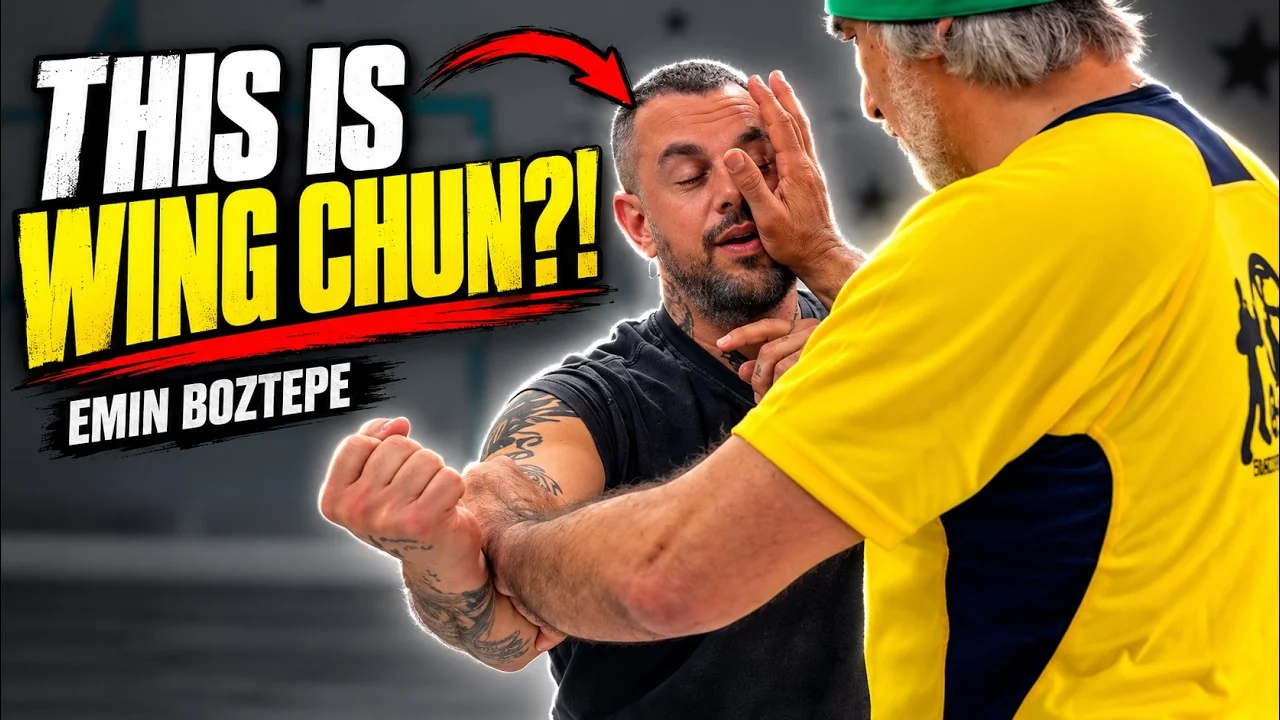
The YouTube channel Inside Fighting has a simple idea: the host does not just watch a martial art, he feels it on his own body. He is a Brazilian Jiu-Jitsu black belt who has tried many styles. In the new episode, he stands opposite Dai Sifu Emin Boztepe, the founder of EBMAS.
The result is 32 minutes with little talk and a lot of contact. You can watch it here: Emin Boztepe’s Wing Chun Is TERRIFYING Up Close (in English). This article is our summary of the main ideas in our own words. It does not replace the video.
The stance: it is not about weight
It starts at the bottom. Wing Tzun and Wing Chun practitioners often debate weight distribution: 40 to 60, or 30 to 70? Dai Sifu Boztepe turns the question around. What matters to him is tension in the adductors, the muscles on the inside of the legs. They keep the foot in place, not body weight.
The host is invited to sweep the leg and does not get far. Even when the foot leaves the ground, Dai Sifu Boztepe is not fighting for balance. From that spring-like tension he then moves forward explosively, at the age of 64, as he mentions himself.
Self-criticism instead of a sales pitch
Anyone expecting an advert for Wing Chun will be surprised. Dai Sifu Boztepe calls himself the biggest critic of his own art. In his view, many schools keep students busy with ever new programmes until they forget how to sweat. His own demand is short: suffer, repeat, understand.
Four attacks, one answer
One of the smartest moments comes when he asks the host to throw a slap, a hook, a wide “ex-girlfriend” slap and a roundhouse kick, one after another. What is the difference? Only the distance, he says. The angle is the same, so you need one concept rather than four separate defenses. The host recognises this from Filipino martial arts, which also think in angles.
The same logic applies to the low kick. Instead of meeting shin with shin, he hits the thigh before the kick develops its full force. To him, that is physics, not a question of toughness. His argument is practical: a method built on shin against shin is hard to justify to a woman facing a much heavier opponent.
Do not chase the hands
One idea keeps returning: he does not follow the opponent’s arms, he goes to the target along the centerline. He describes Chi Sao, the contact-sensitivity drill of Wing Tzun, in plain terms as a training method, similar to pad work. It builds flexibility and coordination. It is not a fight.
At some point the host sums it up himself: everything Dai Sifu Boztepe does is a strike, never just a block. Blocking is left to the other person.
Where striking power comes from
The longest part of the video is about body mechanics. Dai Sifu Boztepe separates several sources of power:
- Wrist: at very close range, compressing the fist on impact.
- Elbow: pressure from a short distance.
- Shoulder: loose, so the arm works like a whip.
- Spine: the arm stays extended and the impulse comes from the trunk.
The key is which joint works at which distance. When the host tries it, he first pushes like a boxer. It is the most honest moment in the video: a lifetime of different training does not change in five minutes. You believe in what you have practised, is the answer he gets.
Who the system is for
Dai Sifu Boztepe respects the training of MMA fighters and boxers, but he draws a clear line. Sport has rules, weight classes and mostly young athletes. The people he has in mind are homemakers, lawyers, bankers and the girl walking home from school. Why should a smaller person hold on to someone, he asks, when they could hit and run?
On the ground, he stays with the same logic and does Wing Chun rather than Jiu-Jitsu: whoever holds his leg has their own hands tied. A word of caution belongs here. A demonstration cannot show how this plays out against a grappler under full pressure, and no system can guarantee your safety. It is still interesting to see how the host, a BJJ black belt, reacts to it.
For students of both arts, there is another highlight. He talks about his long-time teacher, Grandmaster René Latosa, and shows that angles and footwork are the same in Wing Chun and Latosa Escrima. Mainly the distance changes, because a weapon is involved.
Train, then feel it yourself
The ending is surprisingly conciliatory. Do not talk about other martial arts, train. Be a good person. If you like Karate or Kung Fu, get good at it. If a school lies to you, change schools. And then: train, train, train.
The host closes with a line we can only agree with: you have to feel it to understand it. Read more about Dai Sifu Emin Boztepe and our Wing Tzun programme, or use the school finder to find a school near you. Every EBMAS school offers a free trial lesson.